Two independent bodies of observation — Michael Levin's bioelectric cognition research and decades of Tong Ren practice — are arriving at the same territory. This page documents what each has established, where the convergence is structural, and what remains genuinely open.
Levin is the Vannevar Bush Distinguished Professor of Biology at Tufts University and Director of the Allen Discovery Center. His lab has produced 400+ peer-reviewed publications demonstrating that biological systems store pattern information in bioelectric networks — and that these patterns function as setpoints the body actively defends and works to restore.
Key concepts from his published framework:
Problem-solving capacities exist at every level of biological organization — molecular, cellular, tissue, organ, organism, collective. The body is not a hierarchy of passive components executing top-down instructions. It is a nested system of active agents solving local and global problems simultaneously.
Patterns stored bioelectrically are stable across cellular turnover — cells come and go, but the pattern persists. Levin has demonstrated in peer-reviewed work that these patterns can be rewritten without genome edits, producing lasting morphological changes.
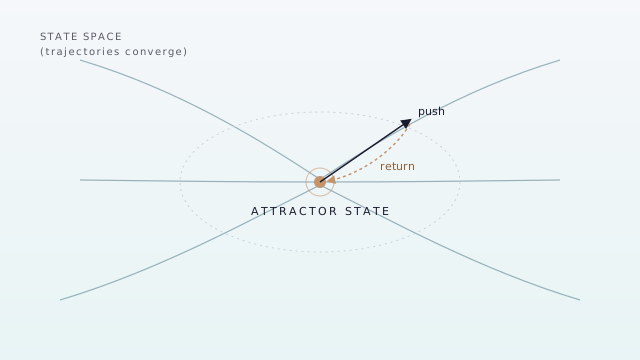
The body maintains closed-loop error minimization toward anatomical setpoints — including dysfunctional ones. These dysfunctional setpoints become attractor states: stable configurations the system actively defends. The body is not broken. It is competent at defending the wrong state. Recovery is not passive. Failure to recover is not passive either.
Bioelectric patterns constitute a software layer running on genetic hardware — reprogrammable, but not through inputs directed at the hardware level.
Simple stimuli can initiate complex downstream cascades. The system is hierarchically organized and responds to signals that address the pattern level, not only the component level.
Primary source: Levin, M. (2026). "Machines All the Way Up and Cognition All the Way Down: Updating the Machine Metaphor in Biology." Seminars in Cell & Developmental Biology.
Tom Tam developed Tong Ren through decades of practice observation across tens of thousands of sessions. The protocol targets specific anatomical reference points along the spine and nervous system — empirically developed, not derived from a single theoretical framework.
Published evidence base: One cross-sectional survey (Sullivan et al., 2009), IRB-approved through Dana-Farber/Harvard Cancer Center. 265 participants. Self-reported benefits across a wide range of conditions. No adverse effects reported. No control group, no blinding, self-selected participants. It is a documented starting point, not evidence of mechanism — and it is cited here because acknowledging the limits of the evidence base is more important than overstating it.
Levin's personal testimony: Levin has known Tom Tam since the 1980s. He has been personally treated by him. He has observed advanced cancer patients in his clinic. His assessment (The Tim Ferriss Show, January 2026): "I can't say anything other than 100% that I think there's something very powerful here. Very significant." He has not stated a mechanism. This is personal testimony about what he has observed — not a peer-reviewed endorsement of the modality.
The Sullivan et al. (2009) survey is the only published study on Tong Ren therapy. It is a cross-sectional observational study with no control group and no blinding. Self-reported outcomes only. It does not establish efficacy and is not presented here as evidence of mechanism.
The convergence between Michael Levin's framework and Tong Ren practice is structural: both describe biological systems that maintain specific states through active, closed-loop feedback processes.
Levin's concept of bioelectric pattern memory — stable but rewritable information stored in physiological circuits — maps onto the blockage patterns that Tong Ren practitioners identify as chronic compression sites along the spine, corresponding to persistent, dysfunctional signaling in the nervous system. Similarly, anatomical homeostasis — the body's active defense of a current physiological setpoint — aligns with the practitioner observation that tissues under sustained load establish and maintain what practitioners describe as high-resistance blockage points along the spine — where elevated resistance reduces the bioelectric current, impeding signal transmission between the brain and organs.
While these observations converge, the specific mechanism connecting them remains an open research frontier.
Chris Fields connects these programs — he has published with both Levin and Donald Hoffman. Levin's framework suggests lasting change requires rewriting internal physiological setpoints, not optimizing behavioral inputs. Hoffman's work raises a complementary question: how much of what we dismiss as implausible is based on perception, not evidence?